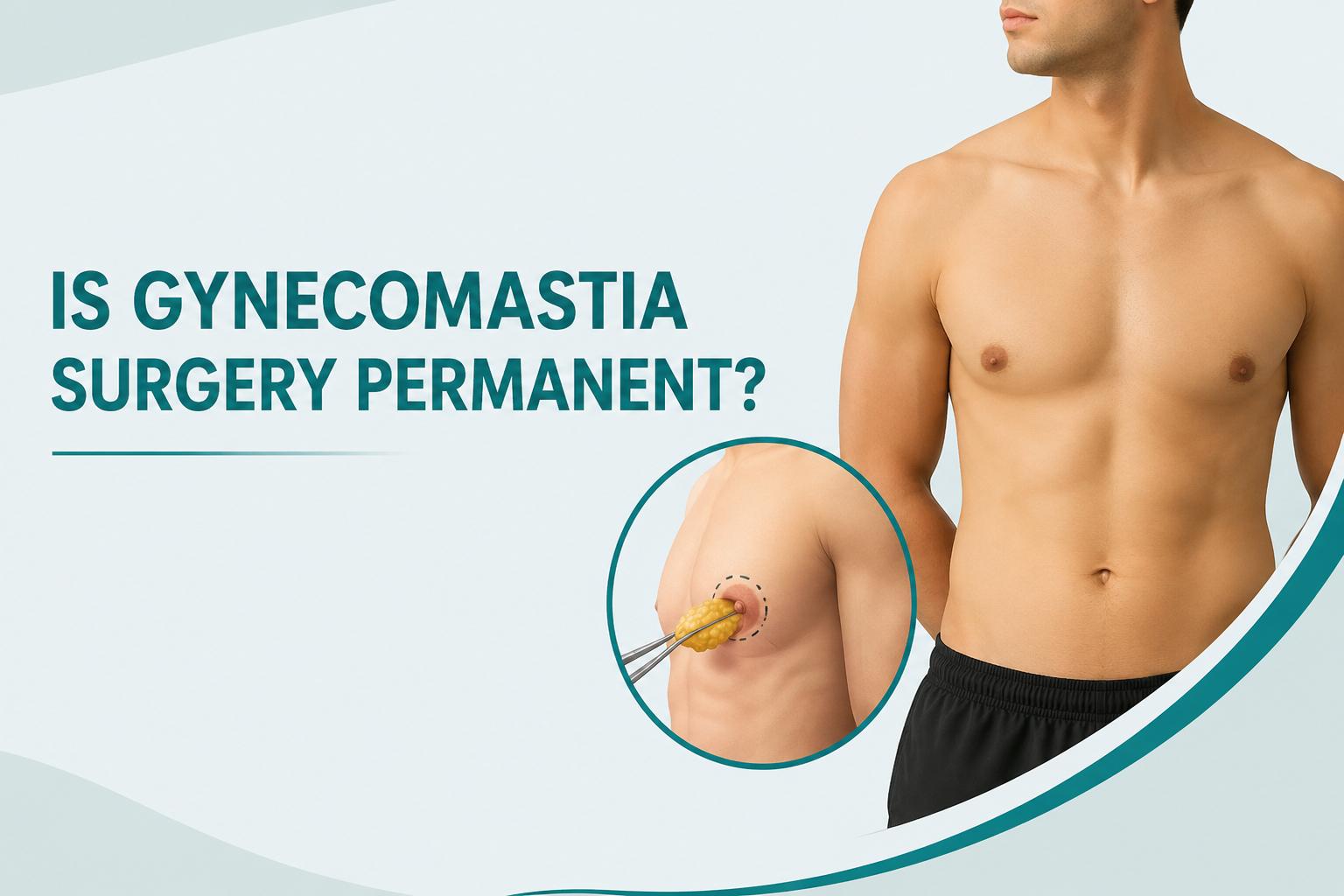
Understanding what happens during gynecomastia surgery can make the procedure feel much less uncertain. Gynecomastia surgery, also called male breast reduction, is performed to reduce enlarged male breast tissue and create a flatter, more proportionate chest. If you are considering treatment in Thrissur, knowing what to expect before, during, and after the procedure can help you prepare properly.
Gynecomastia may develop because of hormonal changes, certain medications, underlying health conditions, or an increase in fatty tissue. Depending on the cause and the amount of glandular tissue, fat, and excess skin present, different surgical techniques may be recommended.
So, what happens during gynecomastia surgery? In general, the process may involve anesthesia, liposuction, surgical removal of glandular tissue, removal of excess skin when necessary, and careful reshaping of the chest. Not every patient requires every step.
This guide explains the procedure in simple terms, including preparation, surgical techniques, recovery, benefits, risks, and important aftercare considerations.
What Is Gynecomastia
Gynecomastia surgery is a form of male breast reduction designed to remove excess breast tissue and improve chest contour. Gynecomastia involves an increase in glandular breast tissue. When enlargement is mainly caused by fatty tissue, it may instead be described as pseudogynecomastia.
The exact answer to what happens during gynecomastia surgery depends on the patient’s chest composition and surgical goals.
The procedure may involve:
- Liposuction to remove excess fat
- Excision to remove firm glandular tissue
- Removal of excess skin in more advanced cases
- Reshaping around the nipple and areola
- A combination of liposuction and excision
The appropriate approach is determined after a physical examination and assessment of the patient’s individual condition.
Causes of Gynecomastia
Before discussing what happens during gynecomastia surgery, it is useful to understand why male breast enlargement develops.
Gynecomastia is commonly associated with an imbalance between testosterone and estrogen. It can occur during different stages of life, including puberty and older adulthood. Certain medications and medical conditions can also contribute.
Common contributing factors include:
- Hormonal fluctuations
- Puberty-related hormonal changes
- Aging-related hormone changes
- Certain prescription medicines
- Some medical conditions
- Increased body fat
- Conditions affecting hormone production
Not every case of enlarged male breasts requires surgery. Some cases improve naturally, particularly when associated with temporary hormonal changes. A medical assessment can help determine the underlying cause and appropriate treatment.
Types of Male Breast Enlargement
Understanding the type of enlargement also helps explain what happens during gynecomastia surgery.
Glandular Gynecomastia
Glandular gynecomastia involves firm breast tissue beneath the nipple or areola. This type of tissue generally cannot be removed through liposuction alone.
Surgical excision may therefore be necessary to remove the firm glandular component.
Fat-Dominant Enlargement
Some men have increased chest volume primarily because of excess fatty tissue. This is often associated with obesity and is sometimes called pseudogynecomastia.
When excess fat is the main issue, liposuction may be an appropriate surgical technique.
Mixed Gynecomastia
Some patients have both glandular tissue and excess fat. In these situations, a combination approach may be used.
Liposuction can reduce fatty tissue, while excision can remove firm glandular tissue. Using both techniques can help achieve a smoother chest contour when clinically appropriate.
Symptoms of Gynecomastia
Gynecomastia may cause both physical and emotional concerns.
Possible symptoms include:
- Enlarged breast tissue
- A firm area beneath the nipple
- Breast tenderness
- Nipple sensitivity
- Chest fullness
- Discomfort caused by friction
- Embarrassment about the chest appearance
Some people also experience reduced confidence when wearing fitted clothing, swimming, or participating in sports.
A new, hard, or unusual breast lump, nipple discharge, skin dimpling, or significant pain should be medically evaluated rather than automatically assumed to be gynecomastia.
What Happens During Gynecomastia
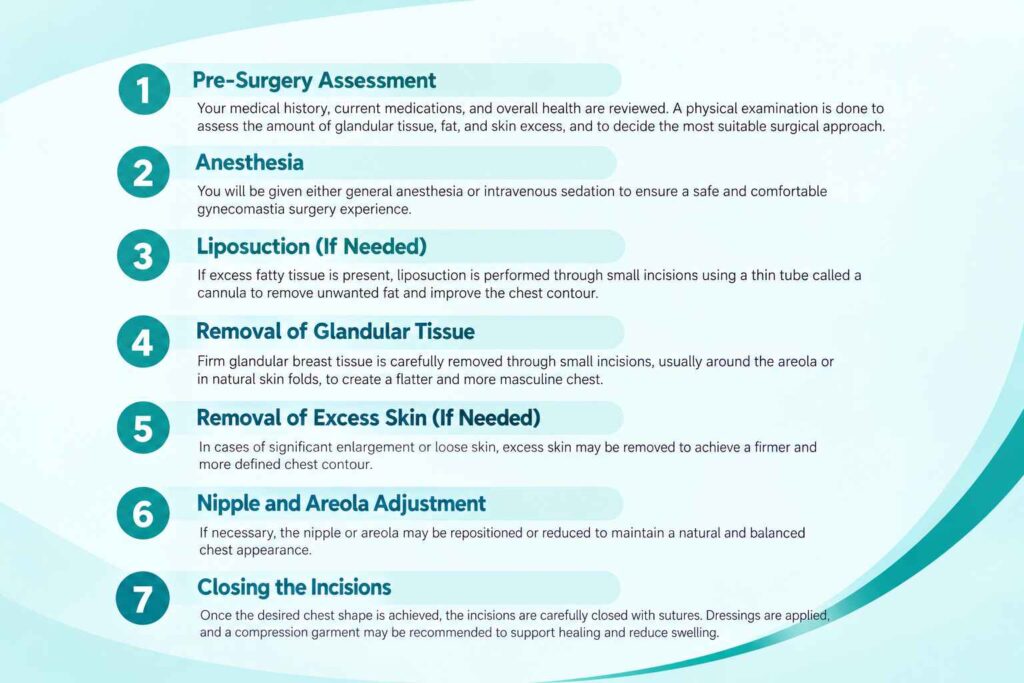
The surgical process varies from person to person, but there are several common stages. Understanding what happens during gynecomastia surgery can help you know what each stage is intended to accomplish.
1. Pre-Surgery Assessment
Before surgery, the healthcare team reviews your medical history, medications, symptoms, and treatment goals.
A physical examination is important because the surgeon needs to determine whether the enlargement is primarily glandular tissue, fat, excess skin, or a combination.
Depending on the clinical situation, additional tests may be recommended to investigate the cause of breast enlargement or rule out other conditions.
The assessment may include:
- Medical history
- Medication review
- Physical examination
- Evaluation of breast tissue
- Assessment of skin quality
- Discussion of desired chest contour
- Relevant laboratory or imaging tests when indicated
2. Anesthesia
The next important part of what happens during gynecomastia surgery is anesthesia.
Anesthesia or sedation is used to keep the patient comfortable during the procedure. Depending on the operation and clinical circumstances, intravenous sedation or general anesthesia may be considered.
The appropriate anesthesia plan is discussed before surgery. Patients should provide complete information about medications, allergies, previous reactions to anesthesia, and relevant medical conditions.
3. Liposuction
If excess fatty tissue contributes significantly to chest enlargement, liposuction may be performed.
During liposuction, the surgeon makes small incisions and inserts a thin tube called a cannula. The cannula is moved in a controlled manner to loosen and remove unwanted fat through suction.
This part of what happens during gynecomastia surgery focuses mainly on reducing fatty volume and improving the contour of the chest.
Liposuction does not remove firm glandular breast tissue itself. Therefore, it may not be sufficient for patients whose enlargement is primarily caused by dense glandular tissue.
4. Removal of Glandular Tissue
When firm glandular tissue is present, surgical excision may be required.
The surgeon makes an incision that provides access to the enlarged tissue and carefully removes the unwanted glandular component. The incision pattern depends on the amount and location of tissue that needs to be removed.
This is an important part of what happens during gynecomastia surgery because glandular tissue generally requires direct surgical removal rather than suction alone.
5. Removal of Excess Skin
Some patients have loose or stretched skin, particularly when there is significant enlargement or substantial changes in chest volume.
In these cases, skin removal may be incorporated into the procedure. More extensive skin removal can require larger incisions than a procedure involving liposuction alone.
The goal is to create a flatter and more natural-looking chest while considering skin elasticity and overall proportions.
6. Nipple and Areola Adjustment
In more advanced cases, the nipple or areola may need to be repositioned or reduced to maintain balanced chest proportions.
Not every patient needs this step.
Whether it is necessary depends on factors such as the amount of excess skin, breast size, nipple position, and the desired postoperative contour.
7. Closing the Incisions
After the unwanted tissue has been removed and the chest has been shaped, the incisions are closed.
The exact closure method depends on the surgical technique and incision location. Dressings are then applied, and a compression garment may be recommended during recovery.
In some cases, temporary drains may be placed to help remove blood or fluid during the early healing period. The healthcare team will provide instructions for managing them if they are required.
How Long Does Gynecomastia Surgery Take
The duration of what happens during gynecomastia surgery varies according to the surgical technique and the extent of correction required.
A procedure involving liposuction alone may differ considerably in duration from surgery requiring glandular tissue removal, excess skin removal, or several techniques together.
Factors affecting surgical time include:
- Amount of fatty tissue
- Amount of glandular tissue
- Presence of loose skin
- Whether both sides require correction
- Surgical technique
- Need for nipple or areola adjustment
Your surgical team can provide a more specific estimate after evaluating your chest.
What Happens Immediately After Gynecomastia Surgery
Knowing what happens during gynecomastia surgery should also include understanding the immediate recovery period.
After surgery, the patient is monitored while the effects of anesthesia wear off. Many gynecomastia procedures are performed on an outpatient basis, allowing the patient to return home the same day when appropriate.
You may experience:
- Swelling
- Bruising
- Tenderness
- Temporary numbness
- Tightness around the chest
- Mild to moderate discomfort
A compression garment may be recommended to support the healing chest and help control swelling.
If drains are used, the healthcare team will provide instructions for managing them and explain when they should be removed.
Recovery After Gynecomastia Surgery
Recovery is an important part of what happens during gynecomastia surgery because the final appearance does not occur immediately.
During the first few days, swelling and soreness are common. Discomfort generally improves as healing progresses. Recovery time varies according to the extent of surgery and the individual’s healing process.
During the First Week
Focus on rest and following postoperative instructions.
Avoid unnecessary pressure on the chest and take prescribed or recommended medications exactly as directed.
During the Following Weeks
Gradually return to normal activities according to your healthcare provider’s instructions.
Heavy lifting and strenuous upper-body exercise should generally be avoided until you have been cleared to resume them.
Over the Following Months
Swelling gradually decreases, scars begin to mature, and the chest contour becomes clearer.
Final results may take several months to become fully apparent.
Benefits of Gynecomastia Surgery
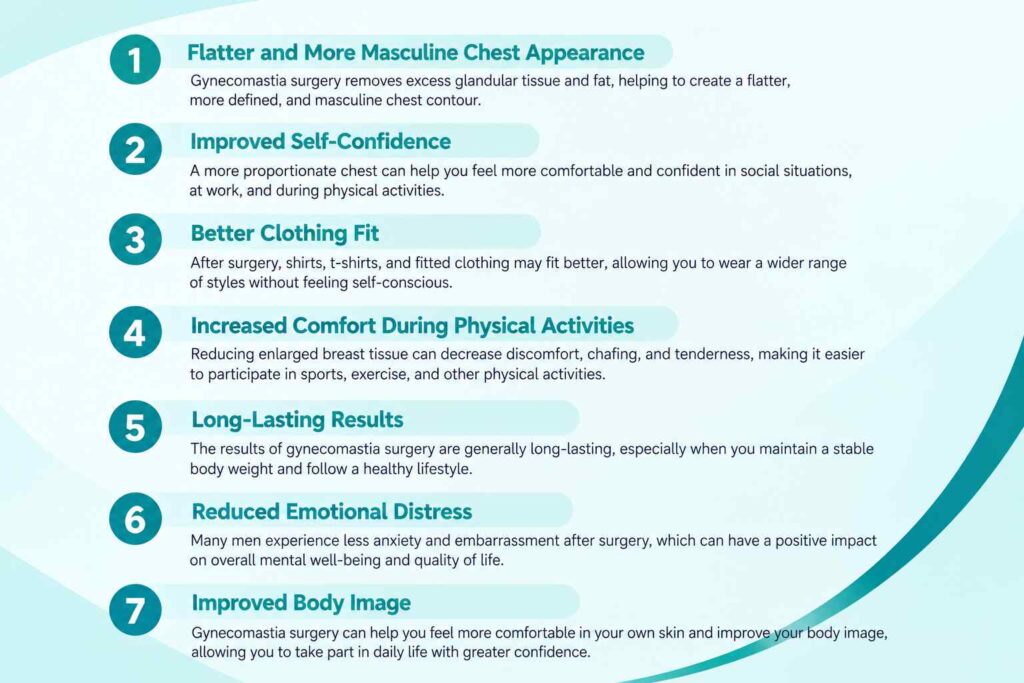
The main purpose of what happens during gynecomastia surgery is to reduce unwanted chest tissue and create a more proportionate chest contour.
Potential benefits include:
- Reduced breast fullness
- Improved chest definition
- A flatter-looking chest
- Better clothing fit
- Greater comfort during physical activities
- Improved body confidence
- Reduction of discomfort associated with enlarged breast tissue
The results are intended to be long-lasting when a stable body weight is maintained and the underlying causes are appropriately addressed.
It is important to maintain realistic expectations. Surgery can improve the physical appearance of the chest, but it cannot guarantee a perfectly symmetrical result.
Risks and Possible Complications
Like any surgical procedure, gynecomastia surgery carries potential risks.
Possible complications include:
- Bleeding
- Infection
- Bruising
- Swelling
- Scarring
- Changes in sensation
- Chest asymmetry
- Contour irregularities
- Persistent pain
- Fluid collection
- Need for additional corrective surgery
These risks should be discussed during the consultation.
Patients should seek prompt medical attention if they experience severe swelling, significant bleeding, pus from an incision, wound opening, fever, increasing redness, severe pain, chest pain, or breathing difficulty.
Tips for a Smoother Recovery
Once you understand what happens during gynecomastia surgery, proper aftercare becomes easier to plan.
Follow Postoperative Instructions
Follow the specific instructions provided by your healthcare team. Instructions may cover wound care, medication, bathing, compression garments, activity, and follow-up appointments.
Wear the Recommended Compression Garment
If a compression garment has been recommended, use it according to the instructions provided. Compression can help support the healing area and control swelling.
Avoid Strenuous Activity
Do not rush back into weightlifting or intense exercise. Returning to strenuous activity too early may interfere with healing.
Maintain a Stable Weight
Significant weight changes after surgery can alter the appearance of the chest.
Attend Follow-Up Appointments
Follow-up visits allow the healthcare team to monitor healing and identify complications early.
Protect Healing Scars
Once your healthcare provider confirms that the incisions have healed sufficiently, follow their recommendations for scar care and sun protection.
Who May Consider Gynecomastia Surgery
Gynecomastia surgery may be considered by men whose enlarged breast tissue persists and causes significant cosmetic or physical concerns.
A suitable candidate generally needs an appropriate medical evaluation and realistic expectations about the outcome.
Surgery may be considered when:
- Breast enlargement has persisted
- Lifestyle changes have not corrected the issue
- The appearance causes significant concern
- Excess glandular tissue or fat is present
- The individual is medically suitable for surgery
- Expectations are realistic
The decision should be made after discussing the cause of enlargement, available alternatives, expected results, and potential risks.
Can Exercise Remove Gynecomastia
Exercise can help reduce overall body fat, which may improve chest appearance when enlargement is primarily related to excess fat.
However, exercise cannot directly remove established glandular breast tissue. This distinction is important when considering what happens during gynecomastia surgery, because surgery is designed to physically remove tissue that may not respond to diet and exercise.
Is Gynecomastia Surgery Permanent
The tissue removed during what happens during gynecomastia surgery is physically removed and does not simply grow back in the same form.
However, future changes in body weight, hormone levels, medications, or underlying medical conditions can influence chest appearance.
Maintaining a stable weight and addressing relevant underlying causes can help support long-term results.
Conclusion
Knowing what happens during gynecomastia surgery helps remove much of the uncertainty surrounding male breast reduction. The procedure may include anesthesia, liposuction, glandular tissue excision, skin removal, nipple or areola adjustment, and careful closure of the surgical incisions. The exact combination depends on the patient’s anatomy and the cause of breast enlargement.
Recovery involves managing swelling and discomfort, wearing recommended compression garments, limiting strenuous activities, caring for the incisions, and attending follow-up appointments. Although gynecomastia surgery can provide a flatter and more proportionate chest, patients should understand both the potential benefits and risks before choosing treatment.
If you are considering gynecomastia surgery in Thrissur, a qualified healthcare professional can evaluate your condition and explain which surgical approach may be appropriate for you. For more detailed information about gynecomastia surgery, you can refer to the American Society of Plastic Surgeons, which explains the procedure, recovery, and potential risks.
Frequently Asked Questions

Dr Prince
Consultant Plastic & Cosmetic Surgeon
Dr Prince is a Consultant Plastic and Reconstructive Surgeon at the Sushrutha Institute of Plastic Surgery, Elite Mission Hospital, Thrissur. He specializes in aesthetic and reconstructive procedures performed in a fully equipped hospital environment with strict safety protocols.
His expertise includes liposuction, rhinoplasty, gynecomastia correction, tummy tuck, breast surgery, and advanced facial aesthetic procedures, with a focus on safe techniques and natural-looking results.
Sushrutha Institute of Plastic Surgery, Elite Mission Hospital, Thrissur, Kerala