7 Essential Facts on Breast Implant Revision Surgery Options
Breast Implant Revision Surgery is a personalised procedure used to address changes involving existing implants, scar tissue, breast shape, or a patient’s preferences. People considering Breast Implant Revision Surgery in Thrissur may seek treatment because of discomfort, rupture, firmness, movement, asymmetry, ageing tissue, or a desire to change implant size. It is not simply a repeat augmentation. The implant, capsule, skin, tissue, chest anatomy, and previous scars must be assessed before a suitable plan is created.
What Is Breast Implant Revision Surgery?
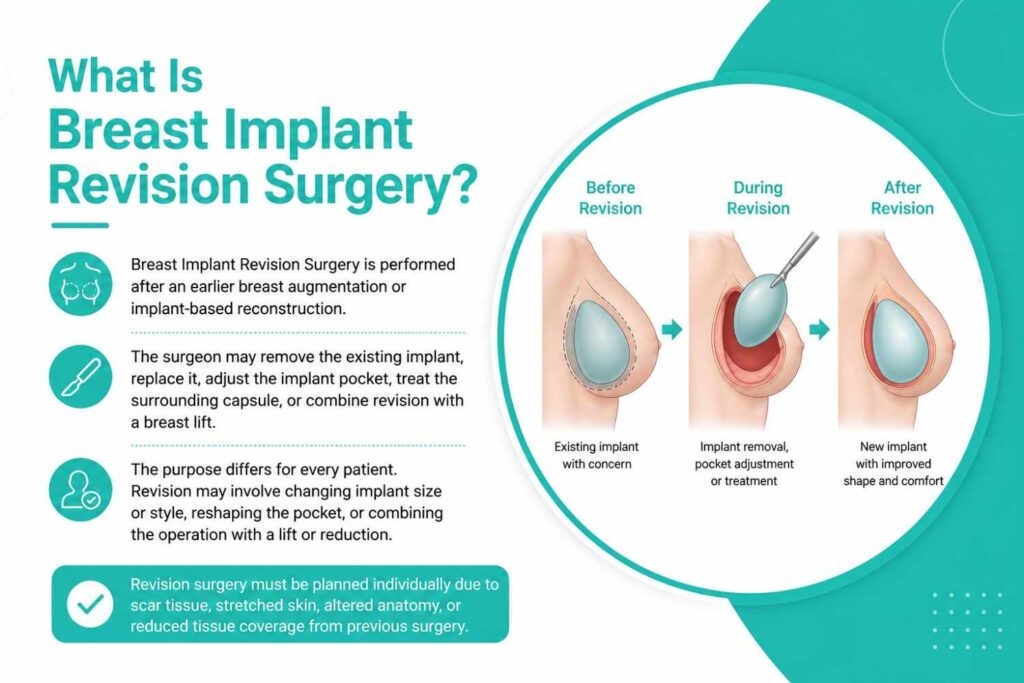
Breast Implant Revision Surgery is performed after an earlier breast augmentation or implant-based reconstruction. Depending on the concern, the surgeon may remove the existing implant, replace it, adjust the implant pocket, treat the surrounding capsule, or combine revision with a breast lift.
The purpose differs for every patient. Some want to correct a medical or mechanical problem, while others want to update appearance. Revision may involve changing implant size or style, reshaping the pocket, or combining the operation with a lift or reduction. Previous surgery can create scar tissue, stretched skin, altered anatomy, or reduced tissue coverage, so Breast Implant Revision Surgery must be planned individually.
Why May Breast Implant Revision Surgery Be Needed?
Breast implants are not lifetime devices. The likelihood of complications can increase the longer implants remain in place, and some complications may require additional surgery.
However, this does not mean every implant must automatically be replaced after a fixed number of years. Revision is usually considered because of symptoms, imaging findings, visible changes, or updated personal goals.
1. Capsular Contracture
The body naturally forms scar tissue around an implant. If this capsule tightens, the breast may feel firm, look distorted, sit higher, or become painful.
Severe capsular contracture may require Breast Implant Revision Surgery to release or remove scar tissue. The FDA notes that severe cases may require reoperation.
2. Implant Rupture or Deflation
A saline implant usually becomes smaller when it leaks. Silicone rupture can be less obvious because the gel may remain within the capsule.
Possible signs include:
- Altered breast shape
- Tenderness
- Swelling
- Lumps
- Numbness
- Increased asymmetry
MRI is the most effective test for silent rupture, while ultrasound is an accepted screening alternative for patients without symptoms.
Breast Implant Revision Surgery may then include implant removal, replacement, and management of leaked material.
3. Implant Malposition
An implant may move too low, too high, too far outward, or toward the centre of the chest. Pregnancy, weight change, tissue stretching, gravity, trauma, a weak implant pocket, or capsular contracture may contribute.
Breast Implant Revision Surgery can reshape and reinforce the implant pocket so that the implant sits in a more suitable position.
4. Rippling or Visible Implant Edges
Thin tissue coverage may allow folds or edges of an implant to become visible or easy to feel.
Breast Implant Revision Surgery may involve:
- Changing the implant
- Adjusting its position
- Using fat grafting
- Improving soft-tissue coverage
- Correcting the implant pocket
The appropriate method depends on skin quality, tissue thickness, implant type, and the location of the rippling.
5. Breast Asymmetry
Natural breasts are rarely identical. Revision may be considered when asymmetry is noticeable, increases over time, or is related to implant position, capsule formation, rupture, or unequal tissue stretching.
The surgeon must identify the cause of the difference before recommending treatment. Simply changing the implant may not correct asymmetry caused by skin or breast tissue.
6. Changes After Pregnancy, Weight Loss, or Ageing
Breast tissue and skin continue to change after pregnancy, weight change, or ageing.
Breast Implant Revision Surgery may be combined with a breast lift when implant replacement alone cannot correct loose skin or nipple position.
7. A Desire to Change or Remove Implants
Some patients want a smaller or larger implant, while others prefer removal without replacement.Size change, capsular contracture pain, rupture concerns, and a change in implant material or style are common reasons for revision.The surgeon should explain how implant removal or downsizing may affect breast skin, volume, fullness, and overall shape.
Symptoms That May Need Medical Assessment
Not every breast change means Breast Implant Revision Surgery is necessary. However, new, unexplained, or persistent symptoms should be properly assessed.
Contact a qualified medical professional if you notice:
- Increasing firmness in one or both breasts
- New breast pain, tenderness, or burning
- A sudden or gradual change in breast size
- Visible asymmetry or distortion
- An implant that appears to have shifted
- Persistent swelling around an implant
- A new lump in the breast or armpit
- Redness, warmth, unusual drainage, or fever
- Skin thinning over an implant
- An implant becoming visible
- Changes following an injury
Persistent swelling, pain, a mass, or other changes around an implant require evaluation. The FDA advises examination and, when indicated, imaging or testing of fluid or tissue.
Sudden swelling, fever, severe pain, wound opening, or breathing difficulty needs urgent medical attention.
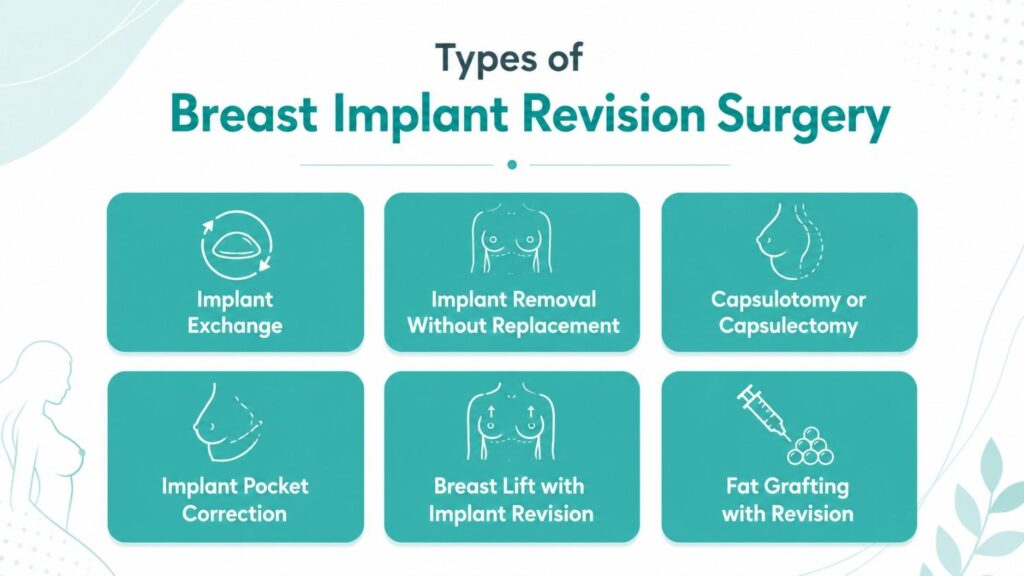
Types of Breast Implant Revision Surgery
The exact treatment depends on why the revision is being performed. More than one technique may be used during the same operation.
- Implant Exchange
The old implant is replaced with one that may differ in size, profile, shape, surface, or filling material.This Breast Implant Revision Surgery option may suit patients wanting an updated size or a different implant type.Changing the implant alone may be sufficient when the breast skin, capsule, and implant pocket remain suitable. Additional correction may be needed when there is sagging, tight scar tissue, or displacement.
- Implant Removal Without Replacement
Some patients choose explant surgery without another implant.
Breast appearance after removal depends on:
- Previous implant size
- Skin elasticity
- Natural breast volume
- Pregnancy history
- Weight changes
- Ageing
- Length of time the implant was present
A lift or fat grafting may be discussed when additional reshaping is desired. Removal without replacement can leave sagging, puckering, dimpling, or other contour changes in some patients.
- Capsulotomy or Capsulectomy
Capsulotomy releases tight scar tissue, while capsulectomy removes part or all of the capsule.Total capsule removal is not automatically necessary for every Breast Implant Revision Surgery. The choice depends on implant condition, symptoms, imaging, suspected disease, and the risks of more extensive dissection.Patients should ask their surgeon why a particular capsule technique is being recommended and what additional risks it may involve.
- Implant Pocket Correction
The implant pocket is the internal space that holds the implant. If this pocket becomes stretched, weak, or incorrectly positioned, the implant may move.The surgeon may tighten, reinforce, or recreate the pocket during Breast Implant Revision Surgery. Internal sutures or tissue-support techniques may be used according to tissue strength and the degree of displacement.
- Breast Lift with Implant Revision
A breast lift removes excess skin and repositions breast tissue.It may accompany Breast Implant Revision Surgery when changing the implant alone cannot correct sagging, loose skin, or a low nipple position.Combining procedures can create additional scars and may affect recovery. The advantages and limitations should be discussed before surgery.
- Fat Grafting with Revision
Fat grafting may improve tissue coverage, contour transitions, or minor asymmetry.Fat is collected from another part of the body, processed, and carefully placed in selected breast areas. More than one session may be required because not all transferred fat remains permanently.
What Happens During Breast Implant Revision Surgery?
Breast Implant Revision Surgery is generally performed under anaesthesia in an appropriately equipped surgical setting.
An existing scar may be used whenever practical. However, a different or longer incision may be required for safer access, capsule treatment, a breast lift, or removal of leaked material.
The procedure may include:
- Opening a previous or planned new incision.
- Removing the implant and assessing the capsule.
- Releasing or removing scar tissue when indicated.
- Managing rupture material and repairing the pocket.
- Inserting a new implant when planned.
- Adding a lift, fat grafting, or tissue adjustment if required.
- Closing the incisions and applying dressings.
The FDA lists implant removal or replacement, capsule surgery, scar revision, drainage, and implant repositioning among possible reoperation steps.
The duration of Breast Implant Revision Surgery depends on the complexity of the correction. A simple implant exchange may take less time than capsule removal, implant pocket reconstruction, or a combined breast lift.
Benefits of Breast Implant Revision Surgery
After careful assessment, Breast Implant Revision Surgery may offer:
- Relief from firmness or pain caused by a tight capsule
- Removal of a ruptured or deflated implant
- Replacement of an ageing or damaged implant
- Correction of implant displacement
- Better balance between the breasts
- Improved implant coverage
- Correction of visible implant edges
- Adjustment to a preferred implant size
- A change in implant material or style
- Implant removal when personal goals change
- Combination with a breast lift to address loose skin
These are potential benefits, not guaranteed results.
Scars, thin tissue, previous complications, skin stretch, and individual healing response may affect the outcome. A realistic discussion is an important part of planning Breast Implant Revision Surgery.
Recovery After Breast Implant Revision Surgery
Recovery varies according to the amount of work performed.
A simple implant exchange may heal differently from capsule removal, implant pocket reconstruction, or a combined breast lift.
Early recovery symptoms may include:
- Swelling
- Bruising
- Chest tightness
- Tiredness
- Temporary sensation changes
- Mild to moderate discomfort
- Limited upper-body movement
Support garments, wound care, medicines, activity restrictions, and scheduled follow-up appointments may be recommended.
Conclusion
Breast Implant Revision Surgery can address implant rupture, capsular contracture, displacement, asymmetry, tissue changes, discomfort, or a personal wish to alter or remove existing implants. The safest plan begins with a complete assessment, review of implant information, appropriate imaging, and an honest discussion about benefits, limitations, scars, recovery, and future monitoring. Because every revision involves different tissue conditions and goals, Breast Implant Revision Surgery should be individually planned rather than approached as a routine implant exchange. Patients considering Breast Implant Revision Surgery in Thrissur should consult a qualified plastic surgeon in an appropriately equipped setting and seek prompt assessment for pain, swelling, firmness, lumps, fever, or sudden breast changes.
For additional information about breast implants and recovery, visit the American Society of Plastic Surgeons (ASPS).
FREQUENTLY ASKED QUESTIONS
- Implant removal without capsule removal
- Partial capsulectomy
- Total capsulectomy
- Capsule release
- Implant replacement with selected capsule treatment

Dr Prince
Consultant Plastic & Cosmetic Surgeon
Dr Prince is a Consultant Plastic and Reconstructive Surgeon at the Sushrutha Institute of Plastic Surgery, Elite Mission Hospital, Thrissur. He specializes in aesthetic and reconstructive procedures performed in a fully equipped hospital environment with strict safety protocols.
His expertise includes liposuction, rhinoplasty, gynecomastia correction, tummy tuck, breast surgery, and advanced facial aesthetic procedures, with a focus on safe techniques and natural-looking results.
Sushrutha Institute of Plastic Surgery, Elite Mission Hospital, Thrissur, Kerala