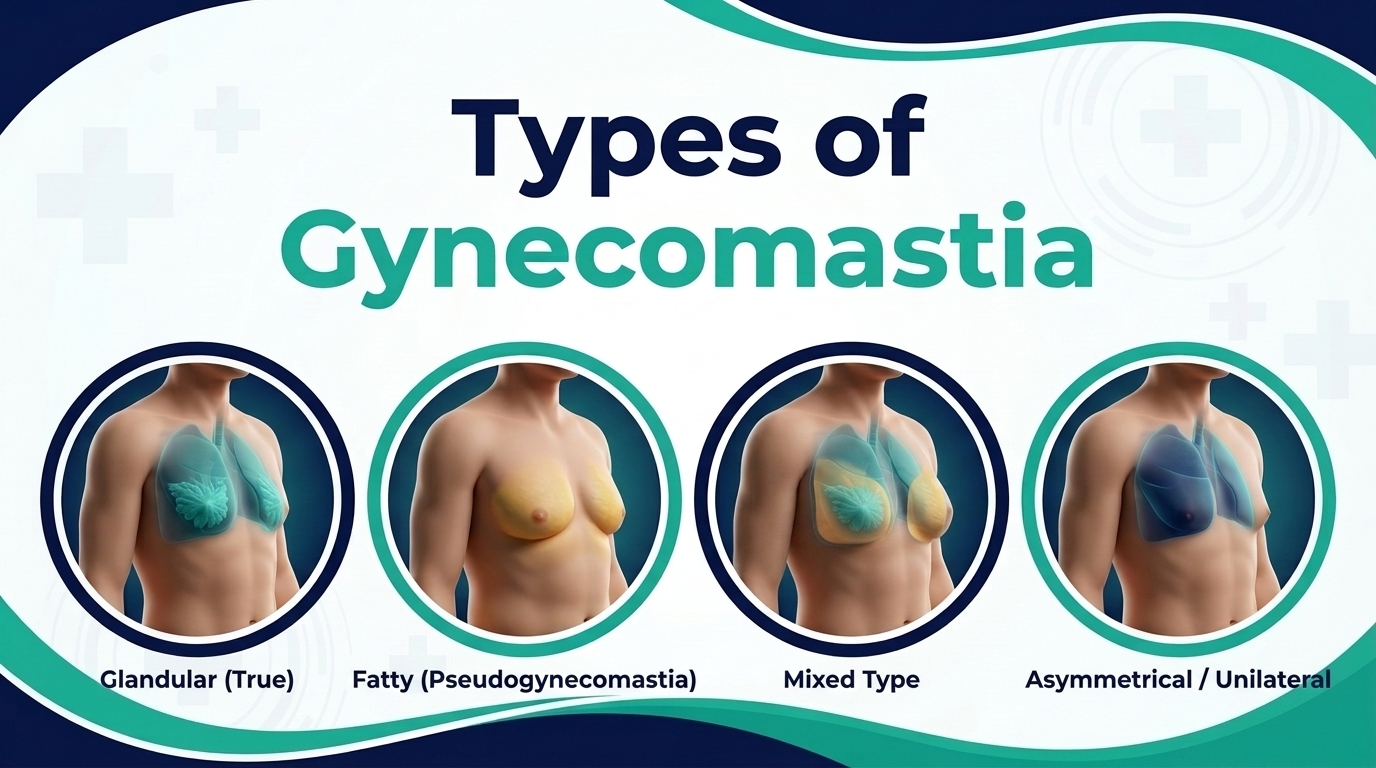
Types of Gynecomastia refer to the different forms of male breast enlargement, which can develop because of increased glandular tissue, excess fat, or a combination of both. This condition can affect boys, teenagers, and adult men at different stages of life. Although male breast enlargement may cause worry or embarrassment, gynecomastia is often benign and can be assessed by a qualified healthcare professional.
Understanding the types of gynecomastia helps patients and their families recognize why chest enlargement occurs and why treatment differs from person to person. Some men develop firm tissue beneath the nipple, while others notice soft fullness across the chest. In some cases, both glandular tissue and fat contribute to the appearance.
For individuals seeking information about male breast enlargement and treatment options in Thrissur, learning about the different types is a useful first step before deciding whether medical evaluation or treatment is necessary.
1. What Is Gynecomastia?
Gynecomastia is the enlargement of glandular breast tissue in males. It can affect one breast or both breasts and may appear as a small, firm area beneath the nipple or as more noticeable chest fullness. Hormones influence how this tissue develops. In males, testosterone supports many aspects of male development, while estrogen also plays a normal role in the body. When the balance or activity of these hormones changes, breast gland tissue may grow.
Gynecomastia can occur during infancy, puberty, adulthood, and older age. During puberty, for example, temporary hormonal changes can cause breast tissue to enlarge. In other cases, medicines, certain medical conditions, or other factors may contribute. It is important to understand that gynecomastia is not always caused by excess body weight. Slim men can also develop glandular breast enlargement, and exercise alone may not remove this tissue. The condition is usually noncancerous, but not every chest enlargement is gynecomastia. A healthcare professional can examine the chest and determine whether the change is caused by glandular tissue, fat, or another condition.
2. True Gynecomastia: Enlargement of Glandular Tissue
True gynecomastia occurs when the glandular tissue inside the male breast becomes enlarged. This tissue is usually located beneath the nipple and the surrounding darker area called the areola. People with true gynecomastia may notice a firm or rubbery area beneath the nipple. Some experience tenderness, particularly when the enlargement first develops. Others have no pain but notice that the chest looks fuller than before. Hormonal changes are a common reason for this type of breast enlargement. Certain medicines and medical conditions can also contribute. In many cases, particularly during puberty, no serious underlying problem is found.
One important feature of true gynecomastia is that glandular tissue does not reliably disappear through exercise or weight loss alone. Chest workouts can strengthen the muscles beneath the breast, but they do not directly remove enlarged breast glands. Treatment depends on the person’s age, the cause of the enlargement, how long it has been present, and whether it causes discomfort. Some cases improve naturally, while persistent enlargement may be evaluated for other treatment options, including surgery. A medical assessment is important before deciding on treatment because the presence of a firm lump or other unusual symptoms may require further investigation.
3. Fatty Gynecomastia: Chest Enlargement Caused by Fat
Fatty gynecomastia is a commonly used term for chest enlargement caused mainly by excess fat. The more precise medical term is pseudogynecomastia, which describes fat accumulation without significant enlargement of the breast gland. This type can occur when a person gains weight and develops additional fat around the chest. The chest may appear soft, rounded, or fuller than expected.
Unlike true gynecomastia, pseudogynecomastia is primarily related to fat rather than glandular tissue. As a result, appropriate weight management may reduce chest fullness in some individuals. A balanced diet, regular physical activity, and sustainable weight-management habits can support general health. However, losing weight does not guarantee that all chest fullness will disappear, particularly if glandular tissue is also present.
If excess fat remains despite appropriate lifestyle measures, a healthcare professional can discuss whether further treatment is appropriate. Liposuction may be considered in selected cases when localized fat is the main concern. It is important not to assume that every enlarged male chest is caused by obesity. A clinical examination helps distinguish fatty enlargement from true gynecomastia and mixed gynecomastia.
4. Mixed Gynecomastia: A Combination of Glandular Tissue and Fat
Mixed gynecomastia occurs when both enlarged glandular tissue and excess fat contribute to male chest enlargement. This combination is common in clinical practice and can make the chest appear fuller than either component would alone.
For example, a man may have firm tissue beneath the nipple along with a softer layer of fat across the surrounding chest. Weight changes may affect the fatty component, while the glandular tissue may remain.
Mixed gynecomastia can occur in men with different body types. A person may have excess body fat and glandular enlargement at the same time, so appearance alone cannot reliably establish the type. Treatment depends on the relative amount of glandular tissue and fat. If surgery is appropriate, the surgeon may consider removing glandular tissue and using liposuction to reduce excess fat. The exact technique depends on the patient’s anatomy, skin quality, and the degree of enlargement.
Not everyone with mixed gynecomastia needs surgery. A medical evaluation can help determine whether observation, management of an underlying cause, lifestyle changes, or a surgical approach is suitable. Understanding this type is particularly important because treating only the fatty component may not fully address the enlargement caused by glandular tissue.
5. Unilateral Gynecomastia: Enlargement on One Side
Unilateral gynecomastia means that breast enlargement occurs on one side of the chest. The affected side may appear larger, more prominent, or different in shape from the other side. This difference can be noticeable even when the enlargement is mild. Some people develop one-sided glandular tissue during puberty, while others notice it during adulthood. Uneven breast development does not automatically mean that a serious condition is present. However, new or unexplained one-sided enlargement deserves medical assessment, especially when it develops rapidly or is associated with other symptoms.
A healthcare professional may examine the chest to identify whether the change is consistent with gynecomastia. Depending on the findings, additional tests or imaging may be recommended. A hard lump, nipple discharge, bleeding, skin dimpling, or changes in the nipple should be assessed promptly. These signs can have different causes and should not be assumed to be ordinary gynecomastia. Treatment depends on the diagnosis and the amount of tissue involved. Some cases require only observation, while persistent enlargement may be evaluated for further treatment. The important point is that one-sided breast enlargement should be assessed based on its symptoms and clinical findings rather than appearance alone.
6. Bilateral Gynecomastia: Enlargement on Both Sides
Bilateral gynecomastia means that both breasts are enlarged. The enlargement may be similar on each side, or one breast may be more prominent than the other. This form can develop during puberty because of normal hormonal changes. It may also occur in adults because of medication effects, certain medical conditions, or changes associated with aging.
Bilateral gynecomastia does not necessarily mean that the enlargement is severe. Some men notice only slight puffiness around both nipples, while others experience more noticeable chest fullness. The amount of glandular tissue, fat, and excess skin can differ between the two sides. These differences may influence how the condition is assessed and treated.
A healthcare professional can examine both sides of the chest and review the patient’s medical history. If an underlying cause is suspected, additional evaluation may be needed. When treatment is considered, the aim is to address the actual cause and, where appropriate, improve chest balance. Surgical planning may take account of natural differences between the two sides. Patients should understand that perfectly identical sides are not guaranteed after treatment because human bodies naturally have some degree of asymmetry.
7. Grade 1 Gynecomastia: Mild Enlargement
Gynecomastia can also be classified according to severity. One commonly used clinical classification describes four grades, ranging from mild enlargement to more pronounced breast enlargement with excess skin. The exact grading system may vary between clinical practices.
Grade 1 generally refers to mild enlargement with little or no excess skin. The change may be limited to slight protrusion around the nipple or a small amount of additional breast tissue. People with mild gynecomastia may notice that the nipple area looks puffy, especially beneath thin clothing. The enlargement may be more noticeable in certain positions or lighting.
The presence of mild gynecomastia does not automatically mean that treatment is necessary. If it develops during puberty and there are no concerning symptoms, a healthcare professional may recommend observation. If the enlargement persists, causes discomfort, or creates significant concern about appearance, a clinical assessment can help clarify the available options. When surgery is considered, the technique depends on whether the enlargement is mainly glandular, fatty, or mixed. The grade alone does not determine the treatment plan. Patients should avoid comparing their chest directly with photographs of other people because tissue composition, skin quality, and natural anatomy vary considerably.
8. Grade 2 Gynecomastia: Moderate Enlargement
Grade 2 generally describes moderate breast enlargement. Depending on the classification system, the chest may appear more rounded or prominent, although significant excess skin may be absent. At this stage, the enlargement may be noticeable even when wearing ordinary clothing. Some men feel uncomfortable during swimming, exercise, or other activities where the chest is visible. The degree of enlargement does not necessarily indicate a more serious underlying disease. However, persistent or unexplained breast changes should be evaluated to establish the cause.
A healthcare professional may assess the amount of glandular tissue, excess fat, skin elasticity, and any underlying medical factors. Treatment may involve observation or management of the cause when appropriate. For persistent enlargement, a plastic surgeon may discuss whether glandular tissue removal, liposuction, or a combination of techniques is suitable. Grade 2 does not automatically mean surgery is required. The person’s age, symptoms, medical history, and preferences all contribute to the decision. A clear understanding of the diagnosis helps patients choose a treatment approach based on their actual needs rather than the grade alone.
9. Grade 3 and Grade 4 Gynecomastia: More Pronounced Enlargement
More advanced grades of gynecomastia involve greater breast enlargement and may include excess skin or drooping tissue. In these cases, the chest can become more prominent and may resemble a more developed breast shape. Grade 3 is commonly used to describe marked enlargement, often with some degree of skin excess or drooping. Grade 4 generally refers to more pronounced enlargement with substantial skin redundancy and drooping. Exact definitions differ across classification systems. People with more pronounced gynecomastia may experience difficulty finding comfortable clothing or feel self-conscious about their chest. Some may also experience skin irritation where folds of skin rub together.
A healthcare professional can assess the tissue, skin quality, and possible underlying causes. If surgery is appropriate, treatment may require more than removing glandular tissue or fat. In selected cases, additional skin removal may be considered. The procedure must be planned according to the individual’s anatomy and needs. More extensive surgery can involve different incision patterns and recovery requirements, which should be discussed during the consultation. Not every case of advanced gynecomastia requires the same procedure. A qualified plastic surgeon can explain the potential benefits, limitations, scars, risks, and recovery expectations before treatment is chosen.